
The Sixth Grade Dilemma
Stay or Go? Navigating the Transition to Middle School
The Big Picture
What happens in the third year?
Academic culmination
<strong>The leap to abstraction:</strong> The final year is when concepts that were introduced with concrete materials fully blossom into abstract understanding.
<strong>Big picture thinking:</strong> Cosmic Education helps them synthesize knowledge across subjects, seeing the interconnectedness of history, science, and math.
Social & emotional leadership
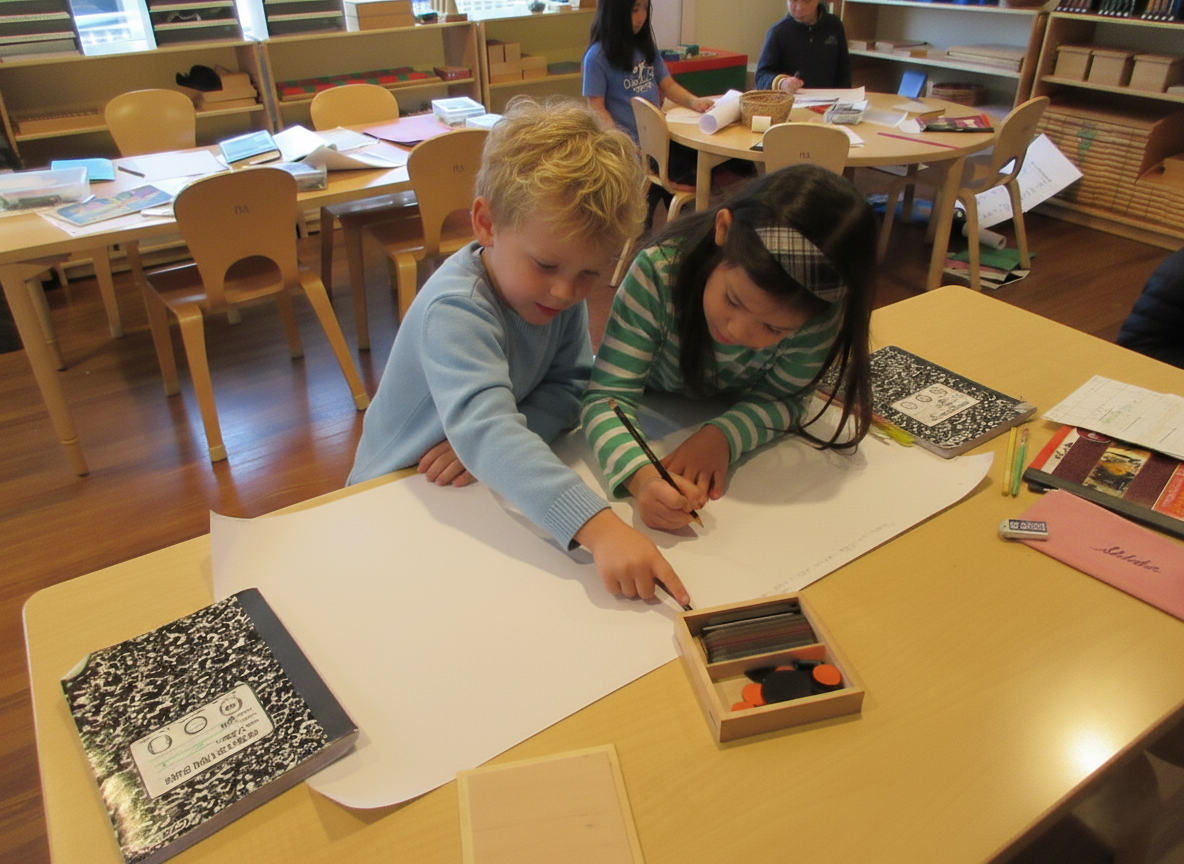
As the oldest in the classroom, they become mentors and role models for younger children, solidifying their own knowledge by teaching others.
This leadership role builds profound confidence, empathy, and a sense of responsibility to their community.
Executive function mastery
Key considerations
| Decision Lens | Staying for Grade 6 (Montessori) | Moving at Grade 6 (Traditional) |
|---|---|---|
| Academic timing | Aligns with the final leap to abstraction in the Montessori curriculum. Completes the three-year developmental cycle. | Starts a new three-year cycle in a traditional middle school setting. May miss the Montessori capstone year. |
| Executive function | Deepens executive function skills through self-directed, long-term projects and leadership roles. | Shifts to a more structured, teacher-directed environment with a focus on following schedules and meeting external deadlines. |
| Social dynamics | Offers a culminating leadership experience as the oldest in the class. Social dynamics are well-established. | Provides a 'fresh start' with a larger peer group, but requires navigating new social hierarchies and structures. |
| Transition load | One major transition after Grade 8, when they are more developmentally ready for the social and academic shifts. | Two major transitions in three years (Grade 6 and Grade 9), which can be demanding during early adolescence. |
Bottom line: There is no 'right' answer, only the best choice for your child and family.
How do I prepare my child for a traditional school?
- Talk about the differences: Discuss the shift from self-directed work to teacher-led instruction, schedules, and grading.
- Practice 'homework': While Montessori students do work at home, formal homework is different. Practice completing and submitting assignments on a deadline.
- Advocate for themselves: Encourage your child to ask teachers for help, clarify instructions, and seek extensions when needed.
- Navigate group work: Discuss the differences between collaborative Montessori work and traditional group projects, which may have different dynamics and grading.
Is my child ready?
Your child might benefit from staying if they...
Thrive on deep, project-based work.
Are a sensitive child who would benefit from another year of social-emotional development before a big change.
Would value the opportunity to be a leader and mentor.
Are academically advanced and would be bored by a traditional 6th-grade curriculum.
Your child might be ready to move if they...
Crave a larger social scene and more team sports.
Are highly motivated by external validation like grades and tests.
Are emotionally resilient and excited for a new challenge and environment.
Final decision checklist
- Have you observed both Montessori and traditional middle school classrooms?
- Have you spoken with your child's current guide about their readiness and developmental needs?
- Have you discussed the options with your child and listened to their feelings and preferences?
- Does the potential middle school offer programs that align with your child's passions (e.g., arts, STEM, sports)?
- Have you considered the logistics of the transition (e.g., commute, social networks, academic calendar)?
Ready to discuss further?
This is a big decision, and we are here to support you. We encourage you to schedule a meeting with your child’s guide to discuss their individual development and readiness.